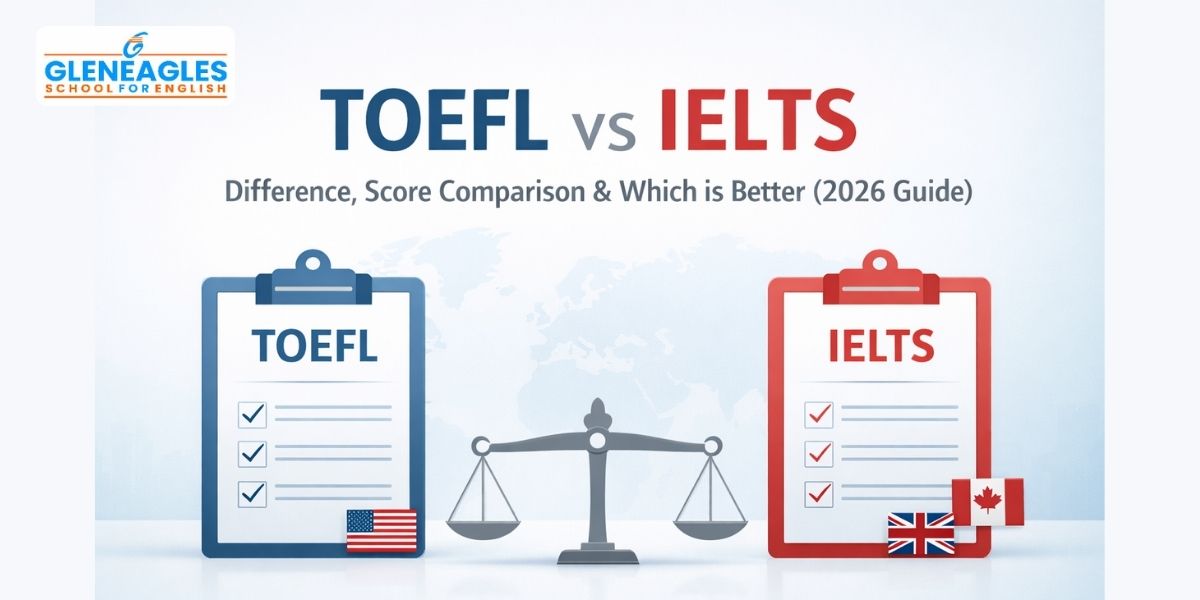
So you've decided to study abroad, congratulations! Now comes the part that confuses nearly every student: TOEFL vs IELTS. Which one should you take? Which is harder? And most importantly, which one will actually get you into your dream university?
Let's settle this debate once and for all with real data, honest comparisons, and zero fluff. If you're based in West Delhi and looking for expert guidance, the TOEFL coaching centre in Vikaspuri at GlenEagles School For English has helped hundreds of students crack both exams. But first, let's understand what you're actually dealing with.
What Are TOEFL and IELTS, Really?
Both are English proficiency tests designed to prove to universities and immigration authorities that you can read, write, listen, and speak in English well enough to survive and thrive abroad. That's the shared purpose. Everything else, from how they test you to how they score you, is quite different.
TOEFL (Test of English as a Foreign Language) is developed by ETS (Educational Testing Service), a US-based organization. It comes in the iBT format, which stands for Internet-Based Test. You take it on a computer, always. The TOEFL iBT is heavily preferred by universities in North America and is widely accepted across the globe.
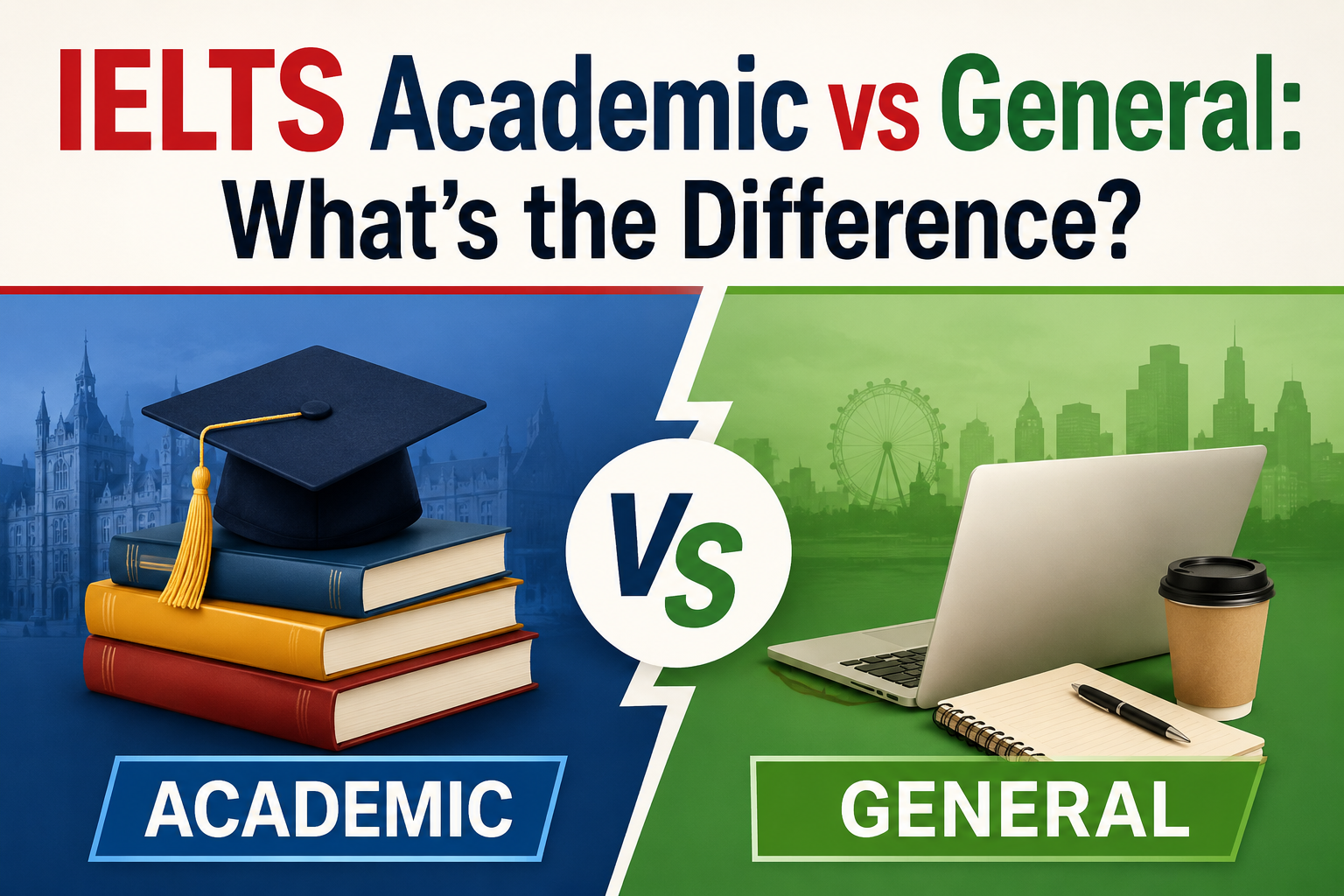
IELTS (International English Language Testing System) is jointly owned by the British Council, IDP: IELTS Australia, and Cambridge Assessment English. It's available in two formats: Academic and General Training. The IELTS Academic version is meant for university admissions, while General Training targets work visas and immigration, particularly for countries like Canada, Australia, and the UK.
One quick fact worth knowing: as of 2024, over 11,500 institutions in 145+ countries accept IELTS scores. TOEFL is accepted at more than 12,000 institutions worldwide. So both are widely respected, the difference lies in where you're going and what you're applying for.
TOEFL Exam Format vs IELTS Exam Pattern: A Side-by-Side Look
Understanding the exam structure is where most students get their first real "aha" moment. Here's how they compare:
TOEFL iBT Format
The TOEFL iBT has four sections: Reading, Listening, Speaking, and Writing. The total test duration is approximately 2 hours (after ETS shortened it in July 2023, yes, they actually made it easier to sit through). The test is entirely computer-delivered. For Speaking, you speak into a microphone and your responses are recorded for evaluation by human raters and AI scoring systems.
IELTS Exam Pattern
IELTS also has four sections: Listening, Reading, Writing, and Speaking. The total duration is about 2 hours and 45 minutes. A key difference: the Speaking section is a face-to-face interview with a certified examiner. That's a live human conversation, not talking into a screen. For many students, that feels either more natural or more terrifying, depending on your personality.
The IELTS writing task structure is also unique. Writing Task 1 asks you to describe a graph, chart, diagram, or process (for Academic), while Task 2 is an essay. TOEFL Writing includes an Integrated Task (where you read a passage, listen to a lecture, and write about both) and an Academic Discussion Task.
TOEFL Score vs IELTS Score: How Do They Compare?
This is where students often get confused, and honestly, it's understandable. The two exams use completely different scoring scales.
TOEFL iBT scores range from 0 to 120, with each of the four sections scored from 0 to 30.
IELTS band score ranges from 0 to 9, reported in half-band increments (like 6.5 or 7.5).
Here's a rough comparison chart based on ETS's official score comparison guide:
Most top universities in the USA require a TOEFL score of 90–100+ or an IELTS band of 6.5–7.0 for undergraduate admissions. For graduate programs, the bar is often higher.
TOEFL vs IELTS for USA, UK, and Canada
TOEFL vs IELTS for USA
If the USA is your destination, TOEFL iBT has historically been the preferred choice. Most American universities were built around it, and admission committees are very familiar with TOEFL score interpretation. That said, IELTS acceptance has grown significantly, and most US universities now accept both. According to ETS, TOEFL is accepted at 100% of universities in the USA.
TOEFL vs IELTS for UK
The UK is firmly IELTS territory. British universities, the UK Visas and Immigration (UKVI) system, and most professional bodies in the UK prefer IELTS. If you're applying to universities like Oxford, Cambridge, LSE, or UCL, IELTS Academic is typically the go-to. Some UK universities do accept TOEFL, but IELTS is the dominant standard. For UK student visas specifically, IELTS is often the mandatory requirement.
What About Canada and Australia?
Canada accepts both, but immigration pathways like Express Entry often use IELTS or CELPIP. Australia's immigration system relies heavily on IELTS. So if your goal is permanent residency rather than just university admission, IELTS General Training is probably the better pick.
TOEFL Speaking vs IELTS Speaking: Which is Harder?
This is genuinely one of the most debated aspects of the TOEFL vs IELTS discussion, and the answer depends on your personal communication style.
TOEFL Speaking has four tasks. You speak into a microphone on a computer. You get preparation time (15–30 seconds) before each response. It feels structured and predictable, which many students find reassuring. However, speaking to a machine can feel awkward — and if you pause unnaturally or mumble, the AI-assisted scoring might penalise you.
IELTS Speaking is a live 11–14 minute conversation with a real examiner. It has three parts: an introduction/interview, a short monologue (called the "cue card" section), and a two-way discussion. Many students find this more natural because it mimics real conversation. On the flip side, if you're nervous in front of people, that examiner's presence can feel like a spotlight.
Neither is objectively harder, it really comes down to whether you prefer structured prompts or natural dialogue.
TOEFL Listening vs IELTS Listening: What's the Difference?
TOEFL Listening features academic lectures and conversations in a university setting. Think: a professor talking about the migration patterns of birds, or two students discussing a research project. The accent is predominantly North American English. You take notes during the audio and then answer questions.
IELTS Listening uses a wider variety of accents, British, Australian, American, and others. The content ranges from everyday conversations to academic monologues. One key structural difference: in IELTS, you hear the audio once, while TOEFL also plays audio once, but the questions appear after each audio clip.
If you're more comfortable with British or Australian accents, IELTS listening might feel more familiar. If you've grown up watching American content (hello, Netflix), TOEFL listening may feel more natural.
TOEFL vs IELTS Validity
Both exams are valid for 2 years from the date of the test. This is standard across the board. Whether you take TOEFL iBT or IELTS Academic, your score report will be considered valid for two years by most universities and immigration authorities. After two years, you'll typically need to retest.
Which is Easier — TOEFL or IELTS?
Here's the uncomfortable truth: neither is "easier." They test the same skill, English proficiency, but through different lenses.
TOEFL tends to be more academically focused, with a strong emphasis on integrated tasks that combine reading, listening, and writing or speaking. If you're comfortable multitasking between different input types, TOEFL can actually feel manageable.
IELTS, especially the Academic version, has a demanding Writing Task 1 that requires you to interpret and describe data, graphs, pie charts, flow diagrams. If data interpretation isn't your strength, this can be a stumbling block.
The bottom line: students who are stronger in academic comprehension and American English often lean toward TOEFL. Students who prefer conversational speaking and British-style English often prefer IELTS. The best thing to do is take a practice test for both and see where you feel more comfortable.
And if you want proper, structured preparation in West Delhi, a reliable TOEFL coaching centre in Vikaspuri can make a huge difference in your score. GlenEagles School For English, findable on Google My Business, offers coaching tailored to both TOEFL and IELTS, so you can get expert guidance before committing to either exam. Their location is listed on their GlenEagles School For English Google My Business profile for easy access.
IELTS Academic vs General: Don't Pick the Wrong One
It is one of the mistakes that occur more frequently than you believe. There are two versions of IELTS, and the wrong version can end up wasting months of study.
IELTS Academic is used by those students who apply to undergraduate or postgraduate programs at the university, as well as by professionals who want to be registered (such as doctors or nurses) in English-speaking countries.
IELTS General Training is for individuals who are seeking secondary school, employment or immigration to other nations such as Canada, Australia, New Zealand or the UK. Reading and Writing are not as complicated as academics, yet do not take them lightly, as good English is still required.
When you are aiming to join a university, always take IELTS Academic. When you are seeking a work permit or PR, you are on the IELTS General path.
Quick Decision Guide: Which Should You Take?
The simplified break down to aid your decision is as follows:
Choose TOEFL if:
You are applying to the USA or Canadian universities.
You like computer based tests.
You are at ease with academic English and combined activities.
You prefer using structured prompts to talk instead of talking live.
Choose IELTS if:
You are applying to UK, Australian or New Zealand universities.
You like in-person speaking interviews.
You're pursuing immigration or work visas
You are more comfortable with the accents of British/Australian English.
Preparing for TOEFL or IELTS in 2026
It is more important how you are prepared than what exam you take whether it is TOEFL or IELTS. The following are some tips that are grounded:
In the case of IELTS preparation, basic practice with writing tasks of band level, listening to BBC podcasts, and reading passages with a time restriction in actual exam conditions is a difference that can be felt. The live speaking interview simulation with a teacher or coach can be of great assistance.
To prepare a guide on TOEFL, learn to work on integrated tasks, learn to summarize lectures using your own words, read scholarly articles in libraries such as JSTOR or even Magoosh (TOEFL) resources and train to do back-to-back tasks.
And yes, provided you are in West Delhi, you can sign up at a reputable TOEFL Coaching Centre in West Delhi or a reputable TOEFL coaching centre in Vikaspuri and get organized mock tests, feedback and exam strategy, which self-study cannot possibly provide.
Final Verdict: TOEFL vs IELTS in 2026 – Which One Should You Choose?
TOEFL vs IELTS debate has no overall winner. They are both internationally accepted, both are demanding and both will ensure you reach where you want to be, as long as your marks are above the required standard.
It is not about your target country, the needs of your institution and your personal capabilities as a test-taker. Research the requirements of your particular university (the vast majority of them are publicly posted), do a diagnostic test on both tests, and then devote full preparation in one of them.
The test that you will study the most is the one you will score well on. It is not a cliche, that is simply the way tests are.
And, in case you still can’t determine which exam to take, you can call us or even call our team to help you with it. We will assist you in selecting the correct test and getting your studying on the correct path.