Choosing the right IELTS exam often feels like standing at a railway station with two trains leaving from the same platform. Both look similar; both promise to take you forward, but only one reaches your destination. That is exactly why understanding IELTS Academic vs. General matters before you register for the exam.
If you're planning to study abroad, apply for immigration, or expand your career opportunities, selecting the correct IELTS test type can save both time and money. Many students visit a trusted IELTS coaching institute in Vikaspuri to understand which exam suits their goals before booking their test. At GlenEagles School For English, experienced trainers help learners identify the right test, understand the latest exam pattern, and prepare with confidence using proven strategies.
In this guide, you'll learn the difference between IELTS Academic and General, compare both IELTS test types, understand their format, and discover which exam aligns with your academic or professional goals. Every fact in this article comes from official IELTS resources to help you make an informed decision.
What Is IELTS?
The International English Language Testing System (IELTS) is one of the world's most widely accepted English proficiency tests. It measures a candidate's English language proficiency across four core skills:
IELTS Listening
IELTS Reading
IELTS Writing
IELTS Speaking
Thousands of universities, employers, professional organizations, and immigration authorities accept IELTS scores as proof of English ability. According to the official IELTS website, more than 12,500 organizations across over 140 countries recognize IELTS for education, work, and migration purposes.
The test is jointly owned by the British Council, IDP IELTS, and Cambridge English, ensuring consistent assessment standards worldwide.
Whether you plan for higher education, a student visa, a work visa, skilled migration, or permanent residency, IELTS offers different modules designed for specific purposes.
Understanding the Two IELTS Test Types
Many first-time test takers assume every IELTS exam is identical. In reality, there are two primary IELTS test types:
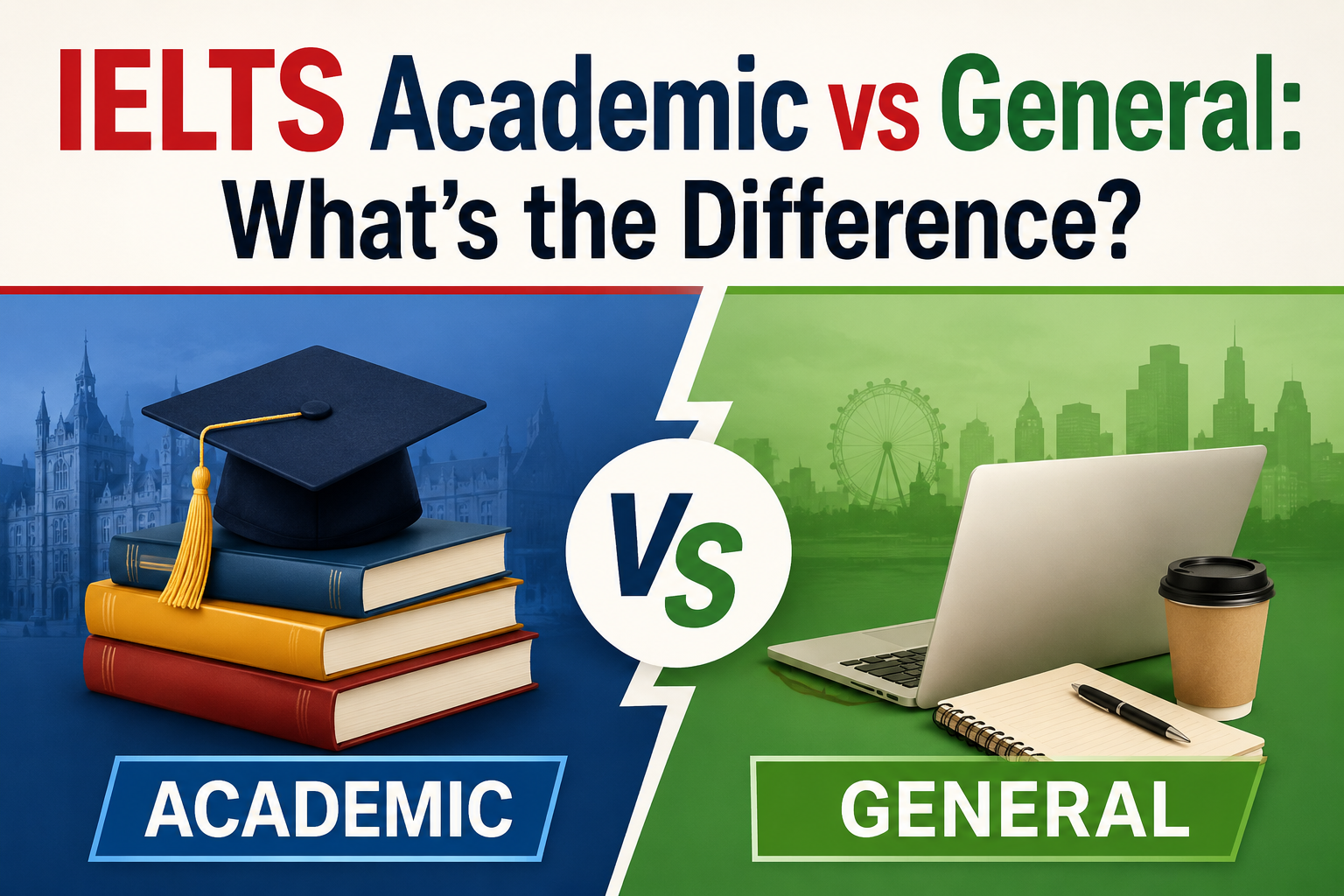
IELTS Academic
IELTS Academic is designed for candidates applying for university admissions, postgraduate programs, or professional registration in English-speaking countries.
The test evaluates whether a candidate can understand and use academic English in classroom and university environments. It includes academic writing, complex reading passages, and tasks that reflect higher education settings.
This version is suitable if you plan to:
Study abroad at undergraduate or postgraduate level
Apply to international universities
Join regulated professions that require English proficiency
Demonstrate advanced academic communication skills
IELTS General Training
IELTS General Training focuses on practical English used in everyday life, workplaces, and community settings.
Instead of academic content, the IELTS General module assesses how well candidates communicate in real-life situations. Reading materials include advertisements, workplace notices, brochures, and general articles, while general writing tasks involve letters and opinion essays. Learners preparing through an english speaking course in Delhi often find this practical approach helpful because it strengthens everyday communication skills alongside IELTS preparation.
The exam is commonly required for:
Immigration applications
Skilled migration programs
Permanent residency
Work abroad opportunities
Secondary education in some countries
Although the Reading and Writing sections differ, the listening test, speaking interview, scoring system, and overall IELTS test duration remain the same for both versions.
IELTS Academic vs General: Quick Comparison
The following table highlights the key differences between both exams.
The biggest distinction lies in the Reading and Writing modules. Listening and Speaking remain identical regardless of the version you choose.
IELTS Exam Comparison: Section-by-Section Breakdown
Understanding the IELTS exam comparison becomes easier when you evaluate each section individually.
IELTS Listening
The IELTS Listening section remains the same for every candidate.
You'll listen to four recorded conversations and monologues before answering 40 questions. These recordings represent different real-life situations, including academic discussions and everyday conversations.
This section measures your ability to:
Understand spoken English
Follow conversations accurately
Identify opinions and facts
Recognize key information
Since every candidate receives the same Listening test, there is no advantage in choosing one module over another.
IELTS Reading
The IELTS Reading section creates the biggest difference between the two exam types.
IELTS Academic Module
The IELTS Academic module includes three longer reading passages selected from books, journals, magazines, and newspapers.
The texts often discuss scientific discoveries, historical developments, environmental issues, technology, education, or research topics. Candidates need strong analytical reading skills and a wide academic vocabulary.
Typical question formats include:
Matching headings
Summary completion
Multiple choice
Diagram labeling
True/False/Not Given
This section reflects the reading demands students usually encounter in universities.
IELTS General Module
The IELTS General module uses practical reading materials instead of academic articles.
Candidates read:
Advertisements
Company policies
Workplace instructions
Public notices
Community information
Magazine articles
The language feels more conversational and practical, although time management still plays an important role.
If your goal involves employment or immigration rather than university studies, this module better reflects the English you'll use in daily life.
IELTS Writing
The Writing section also differs significantly between both exams.
IELTS Academic Writing
The academic writing test includes two writing tasks.
Task 1 asks candidates to describe visual information such as:
Graphs
Charts
Maps
Tables
Process diagrams
Candidates must summarize key trends clearly using formal language.
Task 2 requires an essay responding to an opinion, discussion, or problem-solving question. Examiners assess grammar, lexical resources, coherence, vocabulary, and task achievement.
IELTS General Writing
The general writing test also contains two tasks but focuses on practical communication.
Task 1 requires writing a formal, semi-formal, or informal letter based on a real-life situation.
Examples include:
Requesting information
Making a complaint
Thanking someone
Explaining a situation
Task 2 asks candidates to write an opinion essay similar in structure to the Academic version, although the topics usually relate to everyday life rather than academic issues.
Regardless of the module, examiners evaluate grammar, fluency, coherence, vocabulary, and the ability to communicate ideas effectively.
IELTS Speaking
The IELTS Speaking section remains identical for both exam types.
It is conducted as a face-to-face speaking interview with a certified examiner and usually lasts between 11 and 14 minutes.
The interview consists of three parts:
Personal introduction and general questions
A short speech based on a cue card
A discussion related to the speaking topic
Examiners assess:
Fluency
Pronunciation
Grammar
Vocabulary
Coherence
Your performance determines your IELTS band score for Speaking, regardless of whether you take Academic or General Training.
Who Should Choose IELTS General Training?
IELTS General Training is the right option if your primary goal involves employment or immigration rather than academic study.
Many candidates choose this module when they plan to:
Apply for a work visa
Work abroad
Apply for skilled migration
Seek permanent residency
Meet language requirements for certain immigration programs
Since immigration rules differ by country, verify the required IELTS module on the official immigration website before completing your IELTS registration.
IELTS Eligibility
One of the most common questions candidates ask is about IELTS eligibility.
There are no formal educational qualifications required to take IELTS. Anyone can register for the exam if they need to demonstrate English language proficiency for study, work, or immigration purposes.
However, the official IELTS partners generally recommend the test for candidates aged 16 years or older.
IELTS Registration and Exam Fees
Candidates can complete IELTS registration online through official IELTS partners.
Before booking your exam, choose:
IELTS Academic or IELTS General Training
Preferred test date
Test center
Computer-delivered or paper-based IELTS
The IELTS exam fees differ by country and may change over time. Always check the latest fee on the official IELTS website in your region before registering.
IELTS One Skill Retake
A useful feature for eligible candidates is IELTS One Skill Retake.
If you perform well in three sections but fall short in one, you may be able to retake only that single section instead of repeating the entire exam.
Availability depends on your country, test centre, and the organisations accepting your score. Confirm eligibility with your chosen institution before relying on this option.
Common Mistakes to Avoid
Even well-prepared candidates sometimes lose marks because of avoidable mistakes.
Watch out for these common errors:
Choosing the wrong IELTS module
Ignoring official instructions
Poor time management
Memorizing essays instead of developing ideas
Overlooking grammar accuracy
Limited vocabulary
Not reviewing answers before submission
Preparing strategically is far more effective than simply solving hundreds of random questions.
Choose the Right IELTS Test with Confidence
Choosing between IELTS Academic vs General becomes much easier when you understand your goals. If you plan to pursue higher education, IELTS Academic is usually the right choice. If your focus is on working abroad, skilled migration, or permanent residency, IELTS General Training often meets the required language assessment criteria.
Rather than guessing, take time to review the official requirements of your university, employer, or immigration authority before booking your test. A well-informed decision can save both time and effort.
If you need expert guidance, GlenEagles School For English offers professional support for IELTS preparation, personalized mentoring, and practical exam strategies tailored to your goals. Whether you're preparing for study, work, or immigration, our experienced trainers can help you approach the exam with confidence.
Visit our Google Business Profile to read reviews from our learners and contact us to discuss the right preparation plan for your IELTS journey.