Preparing for IELTS Speaking can feel challenging when you do not know what the examiner may ask. The good news is that success is not about memorising a fixed script. The right approach is to understand the test structure, practise a wide range of IELTS speaking topics, and learn how to develop natural, relevant answers.
At GlenEagles School For English, preparation focuses on communication, confidence, vocabulary, pronunciation, grammar, and practical exam strategies. This guide explains the format, question types, sample responses, preparation methods, and ways to work towards your target band score.
What Are IELTS Speaking Topics and How Does the Test Work?
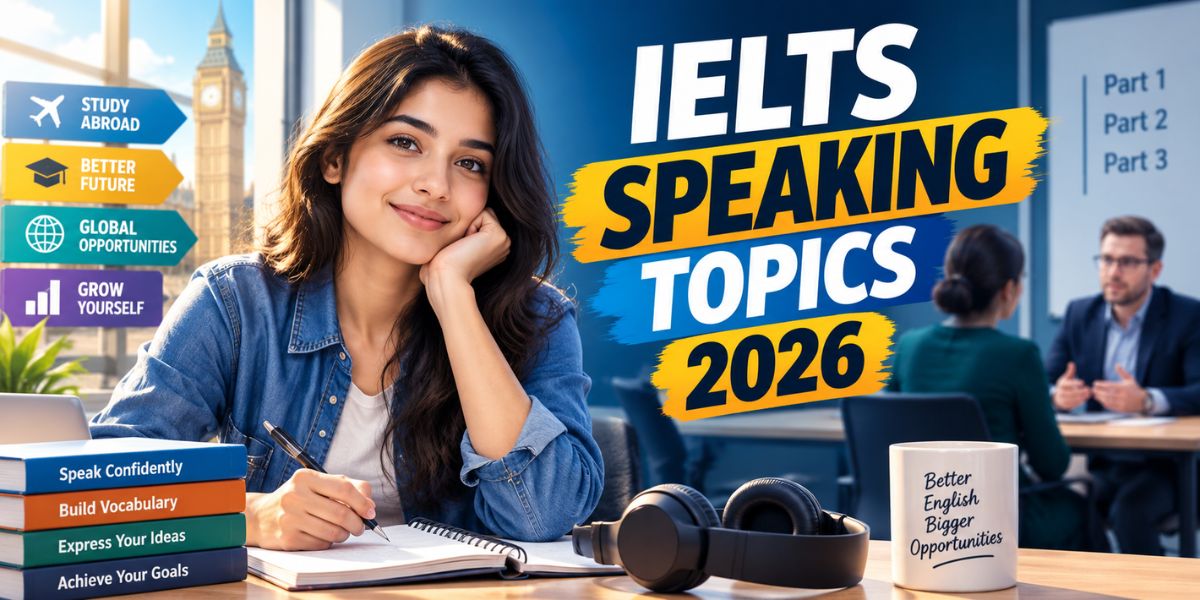
The IELTS Speaking test is a recorded, face-to-face interview with a certified examiner. It lasts approximately 11–14 minutes and contains three parts. IELTS Academic and General Training use the same Speaking test format.
What IELTS speaking topics Should You Prepare?
IELTS Speaking Part 1 covers familiar areas such as your home, hometown, family, work, studies, hobbies, food, travel, technology, books, movies, and daily routines.
IELTS Speaking Part 2 gives you a task card, commonly called IELTS cue cards, followed by one minute of preparation and a longer response. You normally speak for up to two minutes.
IELTS Speaking Part 3 moves into broader and more abstract discussion. Questions may ask you to explain opinions, compare situations, discuss advantages and disadvantages, identify causes and solutions, or make future predictions.
The examiner does not simply look for memorised information. Your performance is assessed through fluency and coherence, lexical resource, grammatical range and accuracy, and pronunciation.
Understanding IELTS Speaking Part 1 Topics
Part 1 is designed around familiar experiences. The questions are usually straightforward, but strong candidates still need to answer naturally rather than giving one-word replies.
Common areas include:
Home and hometown
Family and friends
Work and studies
Food and cooking
Travel and holidays
Technology
Weather
Sports and hobbies
Books and movies
Daily routines and interests
For example, an examiner might ask, “What do you usually do at weekends?” Instead of saying only, “I watch movies,” expand naturally: “I usually spend my weekends with friends or family. If I have enough free time, I enjoy watching a film because it helps me relax after a busy week.”
This approach gives the examiner more evidence of your speaking skills, vocabulary, grammar, and fluency.
How to Handle IELTS Speaking Part 2 Topics
Part 2 is often the section candidates fear most because they must speak continuously. The task card normally provides several prompts, so use them as a simple framework rather than treating them as separate questions.
IELTS Speaking Cue Card Topics and One-Minute Planning
Typical prompts may ask you to:
Describe a person who influenced you.
Describe a memorable place.
Describe an object you use regularly.
Describe an important experience.
Describe an event you enjoyed.
Describe a skill you would like to learn.
Describe a memorable moment.
During the one-minute preparation period, write keywords rather than complete sentences. A useful structure is:
Opening → Background → Main details → Example → Feeling or conclusion
For instance, if asked to describe a memorable trip, quickly note the destination, date, people, activities, special moment, and why the experience mattered.
The official IELTS format confirms that candidates receive one minute to prepare and may make notes before delivering the long turn.
IELTS Speaking Part 3 Topics: From Opinions to Discussion
Part 3 requires more developed thinking. The examiner may connect the Part 2 subject to society, education, technology, culture, employment, health, or environmental issues.
Useful question patterns include:
Why do you think this happens?
What are the advantages and disadvantages?
How has this changed over time?
What could governments or individuals do?
Do you think this will change in the future?
How might younger and older generations view it differently?
A reliable structure is opinion + reason + example + result. This makes it easier to handle opinion questions, discussion questions, and unexpected follow-up questions without sounding rehearsed.
For higher bands, practise explaining ideas rather than simply stating them. Official band descriptors emphasise coherent development, flexible vocabulary, grammatical range, and understandable pronunciation.
Common IELTS Speaking Topics to Practise in 2026
There is no reliable list of guaranteed or “leaked” questions for a particular test date. IELTS states that test development uses rigorous processes designed to maintain comparable difficulty and fairness.
Therefore, prepare broad themes instead of trying to predict one exact question.
Important areas include:
Education and work
Technology and social media
Environment and climate
Health and lifestyle
Travel and tourism
Food and shopping
Sports and leisure
Culture and festivals
Family and relationships
Books, films, and entertainment
Hometown and community
These themes can generate IELTS speaking practice topics for beginners as well as candidates targeting higher bands. Official sample materials are also useful because they familiarise candidates with task types and timed conditions.
IELTS Speaking Topics With Answers: How to Build Strong Responses
Good IELTS speaking sample answers should sound personal, spontaneous, and relevant. Avoid memorising paragraphs because memorised language can become unnatural and difficult to adapt.
IELTS Speaking Topics With Answers 2026: A Simple Answer Formula
For Part 1, try:
Answer → Reason → Small example
For Part 2, use:
Situation → Details → Experience → Reaction
For Part 3, use:
Opinion → Explanation → Example → Broader result
For example, a Part 3 question about technology could receive this response:
“Technology has made communication considerably easier. People can now stay connected regardless of distance, which is particularly useful for families living in different cities or countries. However, excessive screen use can reduce face-to-face interaction, so I think balance is important.”
This is more effective than inserting unnecessarily complicated words. The goal is controlled language, clear ideas, and natural development.
IELTS Speaking Vocabulary, Phrases and Fluency Strategies
Vocabulary matters, but advanced vocabulary is useful only when you can use it accurately. Build topic-specific vocabulary through collocations, useful expressions, linking words, and natural phrases.
For example, instead of repeatedly saying “very important,” you might use “particularly significant” when it genuinely fits the context.
Focus on:
Topic-specific vocabulary
Collocations
Paraphrasing
Linking expressions
Natural idioms used appropriately
Accurate grammar
Clear pronunciation
Strong IELTS speaking vocabulary for common topics should help you express meaning precisely, not simply make your answers sound complicated. Official criteria specifically consider the range, accuracy, appropriacy, and flexibility of lexical resource.
IELTS Speaking Preparation: A Practical Daily Routine
Effective preparation is consistent rather than overwhelming. If you are wondering how to practice IELTS speaking at home, start with 20–30 minutes of focused practice each day.
IELTS Speaking Practice Questions and Recording
Try this routine:
Practise five Part 1 questions.
Complete one cue card under timed conditions.
Answer two Part 3 questions.
Record your responses.
Listen for hesitation, repetition, grammar errors, and unclear pronunciation.
Repeat difficult answers using clearer language.
Doing a weekly mock speaking test can really add some exam pressure and still, in the long run, boost your confidence, kind of like how you learn to handle it. And you can practise with a partner who asks examiner style questions, but please try not to interrupt them too often or too much, otherwise it breaks the flow.
If you actually need some structured IELTS speaking preparation, then an IELTS Coaching Centre in Delhi might help, because they usually give guided practice, proper feedback, and even performance tracking. Also students who are comparing an IELTS Coaching Centre in Delhi should check whether the trainers are focused on real communication, not only memorisation. Because speaking is more about speaking, not reciting.
Likewise, an IELTS Coaching Centre in West Delhi can be useful for learners who prefer local classroom support, where things feel more familiar. When you evaluate an IELTS Coaching Centre in West Delhi, consider things like class size, trainer feedback, mock test opportunities, study material, and of course individual attention too.
How IELTS Speaking Is Scored and How to Reach Band 7, 8 or 9
The Speaking score is based on four equally weighted criteria: fluency and coherence, lexical resource, grammatical range and accuracy, and pronunciation.
What Changes at Higher Band Levels?
For band 7 speaking, you should work on speaking at length, organising your ideas, using a flexible range of vocabulary and handling some more complex structures, even if it feels a bit awkward at first.
For band 8 speaking, aim for more flexibility overall , more precision, a really clear and coherent development, plus consistent intelligibility throughout.
For band 9 speaking, the official descriptors are basically expecting communication that’s highly fluent, coherent, precise, flexible, and easy to understand, all the time.
Don’t chase perfection though. Instead, pick the one criterion that you struggle with the most , and practise it deliberately, like, on purpose, for a while.
Choosing Support for IELTS Speaking in Delhi
Sometimes structured guidance really helps if you, you know, struggle with confidence , pronunciation , vocab or even developing ideas while the clock is doing its thing. At GlenEagles School For English they offer IELTS focused learning along with wider English communication growth, and the practice , plus feedback is basically made to help you feel ready for the exam.
If you’re looking for an IELTS Coaching Centre in Janakpuri , don’t just pick the first one. Try comparing the speaking practice quality , the trainer feedback, how solid the mock assessments are, and also how easy it is to reach , before you enroll. The same idea works when you’re researching an IELTS Coaching Centre in Janakpuri for regular classroom preparation.
Also, if your biggest problem is everyday communication, you may want to check an English Speaking Course in Delhi for stronger fluency and confidence. That kind of course can quietly complement IELTS preparation, especially when you need more room for natural conversation , and practical English use in real settings.
Final Takeaway: Make IELTS Speaking Practice a Daily Habit
The most effective preparation isn’t really about predicting every single question. It’s more about getting comfortable talking about familiar topics, coming up with ideas fast, using vocabulary naturally, and answering with confidence when the examiner asks for more you know, those follow-up questions; that’s the thing.
Use official practice resources, record yourself, do timed cue cards, and keep reviewing your mistakes on a regular basis. Honestly, it helps more than people think, like a lot.
If you want some structured guidance, practical feedback, and a more focused learning environment, GlenEagles School for English can help you build a preparation routine that matches your target band score.
Ready to push your speaking forward? Contact our team to talk about your IELTS preparation needs, or check our Google Business Profile to see more about our courses, the location, and the type of student support we offer. Your next step toward stronger English fluency can start with consistent speaking practice today.