For many candidates, IELTS Writing Task 2 feels challenging because it requires more than good English. You need to understand the question, develop relevant ideas, organise an argument, and communicate it accurately within a limited time. This guide, IELTS Writing Task 2: Complete Structure, Question Types and Tips, explains the process from planning to final proofreading. At GlenEagles School for English, we encourage learners to focus on understanding the task rather than memorising essays.
What Is IELTS Writing Task 2?
IELTS Writing Task 2 requires you to write an essay responding to a point of view, argument, or problem. It appears in both IELTS Academic and IELTS General Training, although the broader context and style can differ slightly.
You need to write at least 250 words and normally have about 40 minutes. Task 2 contributes twice as much as Task 1 to the overall Writing score, making it an important part of your IELTS preparation.
A strong response should contain:
A focused Introduction and clear thesis statement.
Well-developed Body paragraphs with supporting ideas.
Relevant Examples and Explanation.
A logical Conclusion.
Appropriate formal or academic language.
The goal is not to use complicated words everywhere. The goal is to answer the question directly and communicate your argument clearly.
IELTS Writing Task 2 Format and Scoring
The basic IELTS Writing Task 2 format is straightforward: read the prompt, identify exactly what it asks, plan your response, write a connected essay, and check your work.
Certified IELTS examiners assess four areas:
These are the official IELTS writing criteria used for Task 2 assessment.
Your IELTS writing score therefore depends on more than grammar. An essay with impressive vocabulary can still lose marks if its ideas are poorly developed or the question is only partly answered.
IELTS Writing Task 2 Question Types
Understanding the question is the first major step. Official IELTS guidance emphasises answering the actual prompt rather than forcing a memorised essay into a familiar category.
Common IELTS Writing Task 2 questions include:
Opinion: “To what extent do you agree or disagree?”
Discussion: “Discuss both views and give your opinion.”
Advantages and disadvantages: Examine both sides and, where required, decide which outweighs the other.
Problem and solution: Explain a problem and propose realistic solutions.
Two-part question: Answer two connected questions in the same prompt.
Positive or negative development: Evaluate whether a change is beneficial or harmful.
For example, an IELTS Writing Task 2 essay may ask whether online education is a positive development. Your response must evaluate that specific issue rather than discussing education generally.
The same principle applies to IELTS essay questions and IELTS essay topics: identify the instruction words before developing your argument.
IELTS Writing Task 2 question analysis
Before writing, underline the key terms and identify every part of the question. This simple habit helps prevent incomplete answers.
Ask yourself:
What is the main topic?
Am I being asked for an Opinion or a Discussion?
Are there two questions to answer?
Do I need to compare Advantages and Disadvantages?
Do I need to explain a Cause, Effect, problem, or Solution?
This approach is more reliable than memorising an IELTS essay template.
IELTS Writing Task 2 Essay Structure
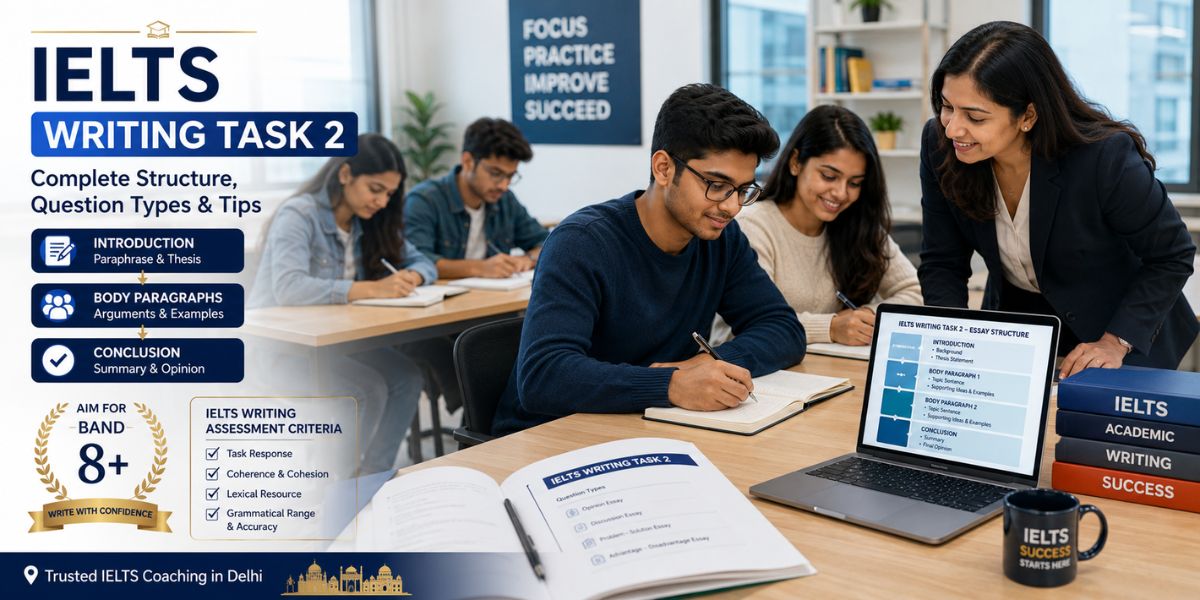
A practical IELTS essay structure usually contains four or five paragraphs:
Introduction: Paraphrase the topic and present your thesis statement.
Body paragraph 1: Introduce your first main idea.
Body paragraph 2: Develop another important idea.
Conclusion: Summarise the central argument and restate your position.
Some questions may benefit from an additional body paragraph, but quality matters more than a fixed number of paragraphs.
A useful IELTS essay format should allow logical progression. Every paragraph should have a clear purpose, with a topic sentence followed by explanation, supporting details, and relevant examples.
How to write IELTS Task 2 body paragraphs
Start each body paragraph with a clear Topic sentence. Then explain the idea before adding an example.
For instance:
Public transport can reduce congestion because one bus can carry many passengers who might otherwise travel separately by car.
The sentence gives a Main idea, explains the relationship, and creates a natural opportunity for a relevant example. This is more effective than simply listing several unrelated points.
Planning and Writing the Introduction
Good IELTS essay writing begins before you write the first sentence. Spend a few minutes on Essay planning rather than immediately starting the introduction.
A useful planning process is:
Identify the question type.
Decide your position.
Select two strong main ideas.
Add one explanation or example for each.
Decide how your conclusion will reflect your position.
When considering how to start IELTS Writing Task 2 essay responses, avoid unnecessarily broad statements such as “Since the beginning of time, people have…”. Begin directly with the subject.
A strong introduction normally contains a paraphrased question and a clear thesis statement. For an opinion question, your thesis should make your position unmistakable.
This also explains how to write a thesis statement for IELTS: state your central answer clearly rather than promising to “discuss the topic” without taking a position.
IELTS Writing Task 2 Vocabulary and Grammar
Vocabulary should be precise rather than unnecessarily sophisticated. Useful IELTS Writing Task 2 vocabulary includes topic-specific terms, accurate collocations, and appropriate Academic vocabulary.
For example, instead of repeatedly writing “very important”, you might use “particularly significant” when it genuinely fits the context.
Grammar also matters. Strong writing may combine:
Simple sentences for clarity.
Compound sentences for connected ideas.
Complex sentences for relationships between causes, effects, and conditions.
Appropriate passive structures where useful.
Focus on IELTS Writing Task 2 grammar through accuracy first. Errors in articles, subject-verb agreement, verb tense, and sentence structure can weaken an otherwise strong response.
Use linking words and Transition words naturally. Cohesive devices should make relationships clearer, not simply fill every sentence with “moreover”, “furthermore,” or “on the other hand”.
How IELTS Writing Task 2 Is Assessed
The official IELTS writing assessment focuses on four areas: Task Response, Coherence and Cohesion, Lexical Resource, and Grammatical Range and Accuracy. To move towards Band 7, Band 8, or Band 9, think beyond vocabulary lists.
For stronger performance:
Task Response: Answer every part of the question and develop your ideas.
Coherence and Cohesion: Organise paragraphs logically and use cohesive devices appropriately.
Lexical Resource: Demonstrate range without sacrificing accuracy.
Grammatical Range and Accuracy: Use varied sentence structures with good control.
An IELTS writing band score is therefore the result of performance across these areas, not one impressive paragraph.
IELTS Writing Task 2 Example and Common Mistakes
Consider a question asking whether governments should spend more money on public transport than roads.
A weak response might discuss transport generally. A stronger response would directly compare government spending priorities, establish a clear Argument, and explain why one investment should receive greater attention.
When reviewing an IELTS Writing Task 2 sample, look for logical progression rather than memorised phrases. Official IELTS guidance specifically warns against learned responses that do not address the actual prompt.
Common mistakes include:
Writing fewer than 250 words.
Ignoring one part of a Two-part question.
Giving examples without Explanation.
Changing your Opinion halfway through.
Using memorised essays.
Overusing Linking words.
Writing long sentences that contain several grammar errors.
Including irrelevant information.
A useful IELTS Writing Task 2 practice routine is to write under timed conditions, then analyse your response against the four assessment criteria.
How to Improve Your Band Score
If you’re aiming for IELTS Writing Task 2 band 9, keep in mind that there isn’t any one vocabulary list or rigid template that will just, by itself, lock in a specific score. Band 9 is about a highly effective task response, clear and developed organisation, sophisticated words used naturally, and grammar that stays consistently accurate.
For people targeting Band 8, the idea also stays pretty much the same. Instead of trying to complicate each sentence on purpose, focus on control, how relevant the points are, how well the ideas are expanded, and the overall precision of what you write.
Practical strategies include:
Complete regular timed essays.
Review your recurring grammar errors.
Build topic-based vocabulary.
Practise paraphrasing questions.
Compare your writing with reliable Sample Answer and Model Answer material.
Ask a qualified teacher to identify weaknesses.
Keep an error log and revisit it weekly.
Students seeking structured support can also consider an IELTS Coaching Centre in West Delhi or an IELTS Coaching Centre in Delhi, particularly when they need feedback on Task Response and paragraph development.
For learners who want to strengthen broader language skills alongside exam preparation, a Creative Writing Course in West Delhi can also help develop confidence with ideas, sentence variety, and written expression. At GlenEagles School For English, structured learning, feedback, and regular practice can help candidates build sustainable writing habits.
IELTS Writing Task 2 Time Management and Best Practices
Effective IELTS Writing Task 2 time management can make a major difference on test day. A practical 40-minute plan is:
5 minutes: Analyse and plan.
30 minutes: Write the essay.
5 minutes: Check grammar, spelling, and word count.
You do not need to write exactly 250 words. The official requirement is a minimum of 250 words, but an excessively long response can reduce the time available for checking and may introduce irrelevant ideas.
Use your final minutes to check:
Subject-verb agreement.
Articles and prepositions.
Spelling.
Repeated vocabulary.
Missing words.
Paragraphing.
Whether your conclusion matches your position.
These IELTS Writing Task 2 tips are simple, but consistent practice is what makes them effective.
Final Thoughts on IELTS Writing Task 2 Preparation
Successful preparation isn't really about memorising an essay. It’s more about learning to understand the prompts, come up with relevant essay ideas, order the main ideas, develop the supporting points, and get your message across accurately, even when you feel a bit rushed or distracted at times.
Try to keep your attention on the four Band descriptors: Task Response, Coherence and Cohesion, Lexical Resource, and Grammatical Range and Accuracy. Use the official practice materials whenever you can, and then review your mistakes, not just keep writing more essays again and again.
If you are after guided preparation, individualised feedback, or a structured learning setting, connect with GlenEagles School For English. You can contact the centre or visit our Google Business Profile to learn more about our IELTS programmes and the support available.