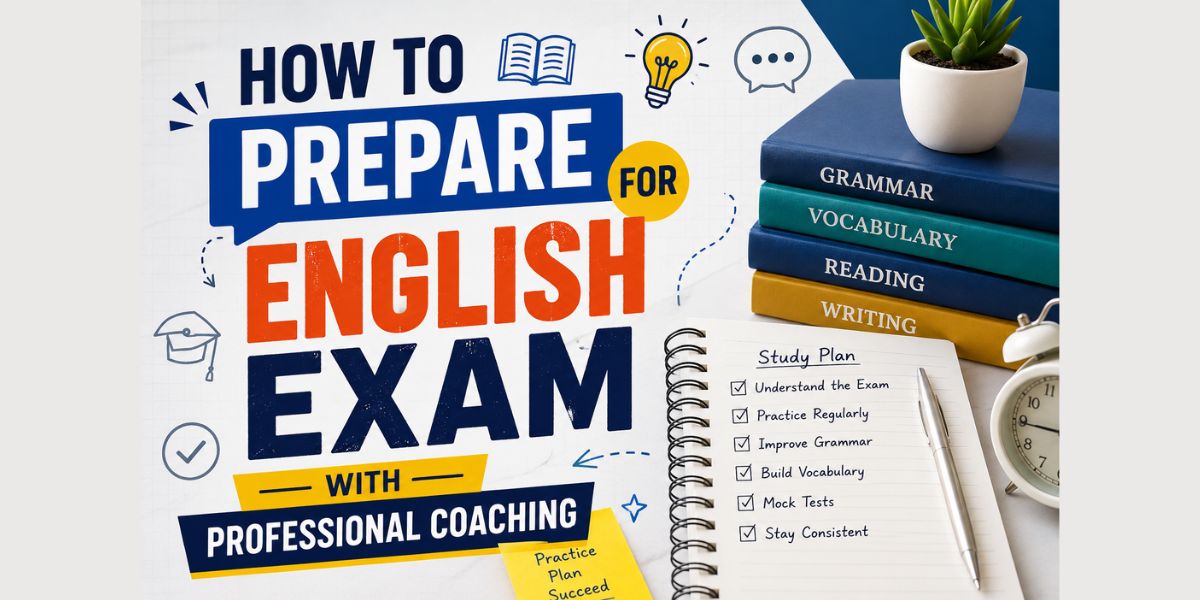
English testing for the English-speaking public can seem like an easy test. After all, most students are texting, watching movies or going through social media in English. However, English for exams is different. Combines grammar, word knowledge, writing, understanding, confidence in speaking and organisation of time in one test. The mix is challenging to prepare for many students.
Last-minute revision isn't enough if you want to learn how to prepare for English exam formats effectively. A huge difference is made when you prepare smartly, practice regularly and are guided by experts. Students in the present time would rather enrol in a reputable PTE Academic Training Centre as they are provided with structure, feedback, and the right exam strategy, which is not found in self-study.
The good news is that English is a subject. English is a subject that will develop gradually as long as good habits are learnt and practised, unlike subjects that rely on memorisation.
Understand the Exam Before You Start Studying
The most common error that students commit is to prepare without knowing the exam pattern. Each of the English exams is organised in a different way. The language skills assessed in IELTS, PTE, school exams and competitive entrance tests are different.
Certain exams emphasise test takers' writing ability, and others place more emphasis on their ability to speak or understand reading. If students miss this step, they tend to prepare the wrong topics, and they will waste precious time.
Before starting your preparation, understand:
The exam sections
Question formats
Time limits
Marking scheme
Common scoring criteria
Typical coaching centres will often describe this information in detail at the start. A good IELTS Coaching Centre in Delhi will surely offer practice tests and latest preparation tips according to the latest exam pattern. Such guidance helps students to avoid confusion and prepare more efficiently.
Also Read: TOEFL vs IELTS: Difference, Score Comparison & Which is Better (2026 Guide)
Build a Study Routine That Actually Works
Students tend to plan unrealistically for their studies. Eight hours of English a day seems like a lot, but most people can't do it that much every day.
Intensity doesn't matter as much as consistency.
The following are the components of a practical study routine, which should involve learning to read, write, practice grammar, learn vocabulary, listen and practice speaking. Staying regular, even with two hours focused, can make a huge difference for the student to perform well.
To study for the English exam success, students should work on their progress each day, rather than concentrating on doing everything required in a few hours. Language learning takes a long time, but it is a steady process. Much can be accomplished in little bits over time.
Students are also disciplined through professional coaching. The consistency that comes from having regular tests, assignments, and fixed schedules provides accountability.
Reading Skills Improve More Than You Think
One of the best natural methods to learn English is reading. Reading well is beneficial to vocabulary, sentence construction, comprehension rate, and writing abilities, all at once.
Students should be reading newspapers, magazines, blogs, editorials and non-fiction regularly. The British Council claims that active reading improves learners' understanding of sentence flow and context vocabulary.
Students should read in order to grasp the ideas, rather than to translate each word. A lot of students study vocabulary but do not learn the rules of word use in actual sentences.
Reading also enhances writing on a subconscious level. After a while, students begin to understand correct sentence constructions and a natural way of using vocabulary.
Reading Instagram captions is not an advanced level of practising comprehension, by the way.
Grammar Still Matters in Every English Exam
A lot of students attempt to find ways to evade grammar, either due to its boredom or difficulty. Unfortunately, grammar seems to be everywhere in English exams. Weak grammar will have a direct impact on the writing, speaking, and comprehension sections, as well as on the sentence correction section.
The students who are studying to be ready for the English exams should start with the foundations to build a strong start. The building blocks of good English are tenses, articles, prepositions, punctuation, and agreement of the subject and the verb.
Typically, professional coaching centres will break grammar down into small, manageable parts. Your students will make incremental improvements rather than get overwhelmed by that approach.
During the writing and speaking sessions, a trusted PTE Academic Training Centre also offers grammar correction. This feedback is extremely useful as students may keep making the same errors without realising it.
Writing Practice Requires Strategy
Writing is one of the highest-scoring and most difficult parts of English exams. A lot of students may be familiar with grammar rules, but they are not able to put their thesis into a logical sequence.
Pupils should regularly set short essays, reports, summaries, and opinion questions. Rather than memorizing essays, concentrate on the interaction between a strong introduction, body, and conclusion.
Cambridge English research shows that regular writing with effective corrections leads to overall accuracy and confidence in language use.
Time management should also be emphasised in students' writing learning in the context of learning English for exam preparation. If a question is taking too much time, it would have an impact on the overall performance of the examination.
That's where professional coaching is very valuable. Trainers are objective in assessing writing and identify areas for improvement.
Students sometimes continue to repeat the same errors without feedback.
Speaking Practice Builds Real Confidence
Many students are scared of speaking. They are concerned with their pronunciation, grammatical errors or faltering speech in their conversations.
When speaking, that fear becomes a big obstacle.
Practising, not being silent, is how English proficiency will be developed. Pupils speak English all the time, even for small amounts of time. Gradual improvement in fluency can be achieved by reading aloud, recording voice notes, engaging in discussions, and practising mock interviews.
Coaching institutes are also popular with students because the practice of speaking is made easier in an instructed classroom setting. A professional IELTS Coaching Centre in Delhi often includes speaking sessions where trainers help students improve fluency, pronunciation, and confidence naturally.
Additionally, students who need reliable advice may seek out GlenEagles School For English, which has been made easily accessible and is supported with coaching through its Google My Business profile location.
Students can prepare for the real exam using Mock Tests and learn to perform well under pressure.
Mock Tests Help Students Perform Better Under Pressure
Regular mock tests should be taken for those who are keen to learn how to prepare themselves for success in their English exams. But, taking tests is not sufficient.
Students will be required to examine errors carefully.
Many students take practice tests and then don't look back at the areas that they struggled on. That habit hinders improvement. Error analysis is always a part of their smart preparation.
The professional coaching institutes typically offer an in-depth evaluation of performance following mock tests. This feedback allows students to get a clearer idea of where they lose marks and how they can improve before the actual exam.
Vocabulary Learning Should Stay Practical
For students, the word count of difficult words is an indication of high marks. This concept puts on extra strain; it is not necessary.
Clear communication is more important than complex communication.
Students should learn vocabulary by reading and in context rather than by rote learning. It follows that the more you know about what they're saying, the more you'll remember.
When looking for tips for students to use in their practical exams for students in English, students should work on their usable vocabulary, which will help them to write and communicate better. Knowing how to use words appropriately in sentences is more important than knowing large lists of words.
It is always easier and more effective to write in simple, accurate English than to write in complex English.
Why Professional Coaching Makes Preparation Easier
Self-study is always relevant, but it needs professional guidance and guidance. Experts can grasp the trends and ways of marking exams, as well as common student errors.
Professional coaching adds value to students by:
Make sure you have a plan for preparation.
Improve speaking confidence
Get regular writing feedback
Solve using mock tests.
Manage time effectively
Be consistent in preparation
A good PTE Academic Training Centre provides a concentrated learning atmosphere in which students master and enhance their skills without getting lost in confusion.
Coaching does not take the place of hard work. It is just making work harder and more productive.
Conclusion
When students use the right strategy to prepare for English exams, they find it easier to do so. To be well prepared, students must read and write often, work on grammar skills, be able to speak confidently, and manage time well.
If students are really dedicated to learning the skills of achieving success in English exams, then they need to avoid any shortcuts and develop true language skills. Better results are achieved through professional coaching, practice and smart preparation.